Is Wireless Charging Bad for Your Battery? What the Evidence Says
No, wireless charging is not bad for your battery. It's safe, it's convenient, and the technology behind it is getting better fast. Modern phones are built with smart systems that protect the battery while they charge, and in combination with a Qi2 Certification this is what keeps everything running safely.
Key takeaways
- Wireless charging does not damage your battery any more than a wired charger does. Decades of phones charge this way every night without trouble.
- What ages any battery is heat, time at full charge, and charge cycles, and your phone manages all three automatically.
- The newest Qi2 chargers are engineered to run cooler than ever, with active cooling and magnetic alignment that reduce wasted energy.
- A Qi2 Certified charger is tested for interoperability, performance, safety and heat. Qi2 chargers have magnetic alignment for a better, more energy efficient charge.
The short answer
No. When you charge a Qi Certified phone on a matching Qi Certified charger, wireless charging will not meaningfully shorten your battery's life.
The worry comes from a real fact: charging generates heat, and heat is what wears batteries down over time. The key is that wireless charging is a two-sided system. The phone and the charger talk to each other, negotiate the right power level, and rely on each being built to the same standard to keep heat in check.
When both are Qi2 Certified, that handshake works the way it's supposed to, the power stays controlled, the alignment is right, and the thermal protections on both ends do their job. More than a billion devices charge this way, many of them every night, and they hold up fine.
The overheating tends to come from the other situation: an uncertified charger, or a mismatch between the phone and the pad, where that coordination breaks down.
What actually ages a battery
To protect a lithium-ion battery, it helps to know what wears one down. There are three real factors, and the charging method isn't one of them:
- Heat. Sustained high temperatures speed up the chemical aging inside a battery. Apple notes that ambient temperatures above 35°C, around 95°F, can permanently reduce battery capacity.
- Time at full charge. Sitting at 100% for long stretches keeps the battery at high voltage, which adds stress over months and years.
- Charge cycles. Every full charge and discharge is a cycle, and a battery is rated for a set number before its capacity starts to dip.
Wireless or wired doesn't appear on that list. What your phone does about these factors is what protects the battery, and modern phones do quite a lot.
Your phone is already protecting your battery
Here's the part the scare stories leave out. The phone in your pocket is actively working to keep its battery healthy, every time it charges.
Most phones learn your daily routine and hold the charge at around 80% until just before you usually wake or unplug, which limits the time spent at a stressful high voltage. They throttle the charging speed as the battery fills, and they watch the temperature the whole way, slowing down if things get warm. Apple calls its version Optimized Battery Charging.
Samsung and others have their own. The effect is the same: the careful management happens automatically, whether you charge with a cable or a pad.
This is why charging overnight, or topping up throughout the day, isn't something to worry about on a Qi2 Certified phone. The protections are doing the thinking for you.
Charging is getting better, not just bigger
The wireless charging you can buy today is a different animal from the pads of a few years ago, and heat is exactly where the progress shows.
The latest Qi2 25W chargers are designed to stay cool under load. Members of the Wireless Power Consortium have built active cooling right into their newest models. Sharge's IceMag uses a built-in fan to pull heat away while it charges at full speed. ESR's CryoBoost line uses a cooling system aimed at the same goal, and Belkin's ChillBoost does likewise across its Qi2 25W range.
When CNN tested a field of wireless chargers, its top pick earned the spot partly for staying cool under load, the cooling clearly working as intended. It was Qi2 Certified, of course.
There's a second, quieter improvement built into every Qi2 charger: magnetic alignment. By snapping the phone into the exact right position over the coil, Qi2 makes the energy transfer more efficient, which means less of it is lost as heat in the first place.
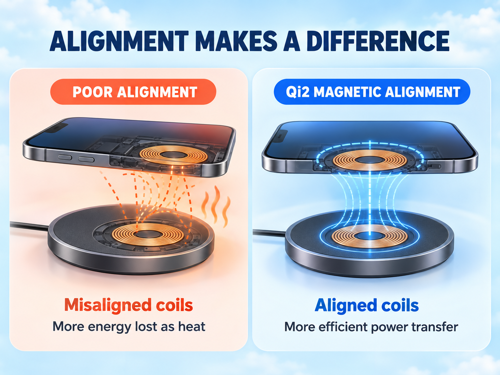
So, the newest chargers attack heat from both directions, preventing it through better alignment and removing what's left through active cooling. The trajectory is clear, and it's pointed at cooler, faster, safer charging.
The real factor: choosing a good charger
If there's one thing genuinely worth caring about, it's the quality of the charger itself. This is where battery safety is actually won or lost.
A cheap, uncertified pad may cut the corners that protect your phone. It might lack proper foreign object detection, the safety feature that stops a charger from dumping power into stray keys or a coin on the pad. It might skimp on thermal management and run hotter than it should. Those are the things that turn ordinary charging into a problem.
Certification exists to rule that out. To earn the right to display the Qi2 logo, a product has to pass independent testing and interoperability against a large pool of real devices. It isn't a marketing sticker. It's proof the charger does the things that keep your battery safe.
A Qi2 Certified charger has cleared that bar. You can confirm any product in WPC's certified product database before you buy.
How to get the most from every charge
A few easy habits cover the rest:
- Use a Qi2 Certified charger. A Qi2 Certified charger is built to manage heat and power safely. This is the single biggest win.
- Give it some air. Charge on a hard surface in a ventilated spot rather than under a pillow or in direct sun, so heat can escape.
- Remove thick case if your phone runs warm. A bulky case can trap heat between the phone and the pad.
- Let optimized charging do its job. Leave your phone's built-in battery protection on, and it will handle the careful timing for you.
Do those, and your battery will stay healthy for years of daily charging.
The sustainability upside
There's an environmental case for wireless charging too, and it comes down to what lasts.
Cables fray. Charging ports loosen and wear out from being plugged and unplugged thousands of times. Those are among the most common reasons a phone needs a repair or an early replacement. Wireless charging sidesteps both, because there's no cable to fail and no port taking the daily strain. A charging surface with no connector simply has less to break.
That matters at scale. The UN's Global E-waste Monitor 2024 found the world generated a record 62 million tons of electronic waste in 2022, with only about 22% properly recycled.
A shared standard helps here in a way a pile of proprietary chargers never could. Because Qi2 works the same across phone brands, one charger serves all your devices and carries over when you upgrade, which means fewer one-off accessories headed for a drawer and then a landfill.
The bottom line
Wireless charging is safe for your battery, and it keeps getting better. Your phone already manages heat and charge level on its own, and the newest Qi2 chargers are engineered to run cooler than anything before them. The one choice that matters is picking a charger that's actually Qi Certified, because that's your guarantee of the safety and quality that keep your battery healthy. Look for the Qi2 logo, confirm it in WPC's certified product database, and charge with confidence.