7 Kitchen Tech Upgrades That Will Future-Proof Your Kitchen
Kitchen technology has gotten past the phase where it meant a screen on a refrigerator door. The interesting things happening in kitchens right now are structural: power moving through solid stone, appliances losing their cords, entire categories that are ordinary in Chinese and European homes showing up on American shelves.
Here are seven worth knowing about. Some you can order this week. Others are still in development but coming soon.
Highlights
- Companies like FreePower are integrating Qi wireless charging right into countertops and other surfaces being used in kitchens, restaurants, offices and airports all over the world.
- Ki Cordless Kitchen appliances draw power straight through the counter surface, with first products expected in some markets in 2027.
- In-sink dishwashers and instant boiling taps are becoming more and more common in Asia and Europe.
- Smart appliances are easy to buy and hard to combine, so favor open standards over any feature that only works inside one brand.
1. Wireless charging countertops
Status: available now, during fabrication only
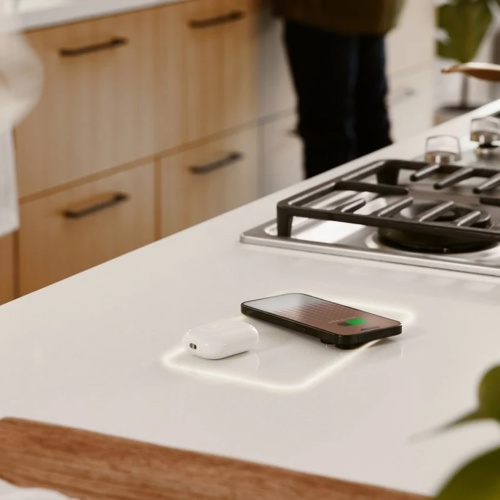
FreePower builds a wireless charging system that goes underneath a countertop while the counter is being fabricated. A section of the surface becomes a charging area. Set a phone down anywhere inside the zone and it charges, with no pad, no cable and no visible hardware anywhere on the counter. A feature called the FreePower Charging Halo™ lights up through the stone so the active area is findable, which matters more than it sounds like it should.
The system runs three devices at once at 15 watts each and works through standard kitchen counter thicknesses. Natural stone such as granite, quartzite, and marble; quartz and engineered stone products like Silestone and Dekton; as well as porcelain all work. Cosentino has integrated it into Silestone and Dekton, and it is carried through several hundred fabricators and showrooms across the United States.
One constraint decides whether this is available to you at all: it cannot be retrofitted. The hardware is installed as part of making the countertop, so an existing counter that is already cut and mounted is not a candidate. Fabrication day or never.
FreePower is featured in hundreds of showrooms across North America today.
2. Cordless kitchen appliances
Status: coming, 2027
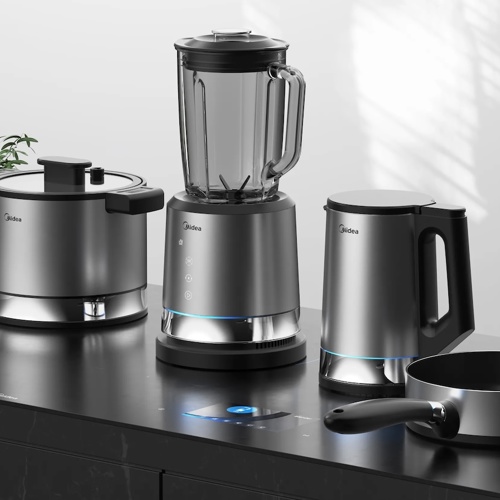
Charging a phone through a countertop takes a few watts. Running a blender takes a great deal more, and that is what the Ki Cordless Kitchen standard was built for. Ki delivers up to 2,200 watts through a counter or cooktop surface to an appliance sitting on top of it. No cord, no plug, no outlet behind the toaster.
The prototypes shown at CES 2026 included kettles, blenders, toasters, food processors and a waffle maker, built by member companies including Philips, E.G.O., Midea, WMF and Jabil. Version 1.0 is finished and certification testing opened in 2025, which is the point where products stop being demonstrations and start being things a manufacturer can put a certification logo on.
The NFC Forum added certification for cordless kitchen appliances in early 2025, since the surface and the appliance have to recognize each other before any power moves between them.
First products are expected to reach some markets in 2027. The first version of the standard covers cooktops and standalone countertop units, and a later version adds concealed transmitters that sit hidden under a finished surface with nothing visible at all. Concealed may be attached under existing countertops depending on the cabinet configuration and the space between the top of a drawer and the bottom of the countertop.
3. Workstation sinks and island prep integration
Status: available now
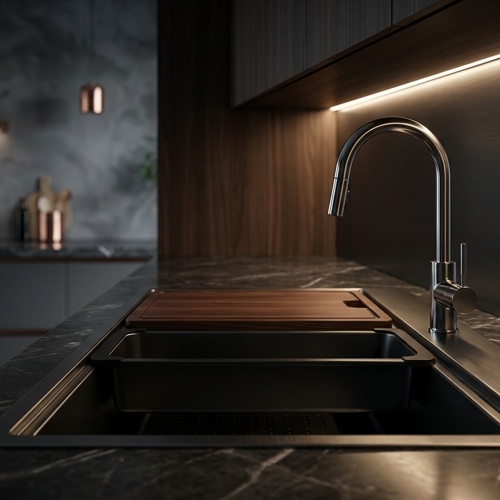
The sink stopped being a place to rinse things and became the busiest work surface in the kitchen. Workstation sinks build ledges into the basin walls so accessories slide along the length of it: cutting boards that sit at counter height over the water, colanders that drain straight down, drying racks, prep bowls. You wash, chop and drain in one place instead of carrying wet food across the counter.
The island versions go further. Integrated sinks positioned on the island rather than against a wall put the prep zone in the middle of the room, facing outward, which changes the whole traffic pattern of a kitchen. Add a touchless pull-down faucet and the messy-hands problem largely disappears. Pair it with an under-island bin and food waste goes from board to bin without a detour.
Adjacent integrations worth planning at the same time: a pull-out cutting board with a waste chute cut into it, drawer dividers sized for trays and boards rather than left generic, and an appliance garage so the things you use daily are on the counter without being on display. None of this is expensive relative to the rest of a kitchen. It is mostly a matter of deciding before the cabinetry is ordered.
4. In-sink dishwashers
Status: available now, United States
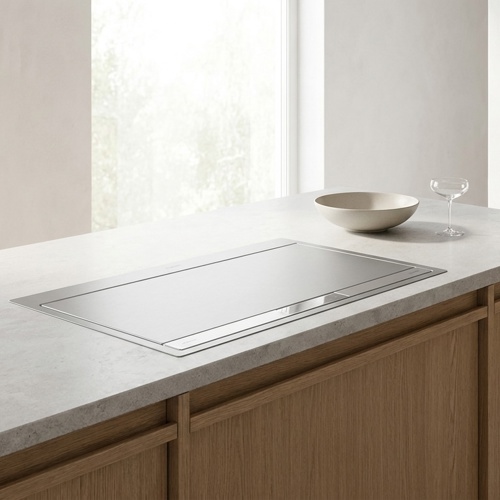
Fotile builds a dishwasher into the sink itself. A category that drew inspiration from Chinese apartment design is now sitting in American big box retail. You load it at counter height rather than bending to the floor, which sounds like a small thing and is not once you have done it once, or twice a day for ten years.
Capacity is smaller than a full size machine, so it suits smaller households, apartments, and anyone who runs a half-empty dishwasher most nights out of habit. It uses a little over three gallons per cycle against roughly six for a conventional dishwasher. It also takes up no floor space, which in a galley kitchen or an accessory dwelling unit is worth more than the water saving.
For a compact kitchen this solves a layout problem rather than adding a feature, which is the useful kind of upgrade.
5. Instant boiling water taps
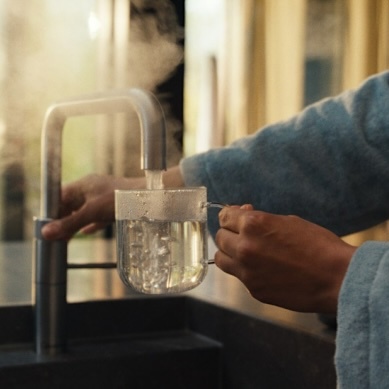
Status: available now
Walk into a British or Dutch kitchen and there is a fair chance the tap does boiling water. Not hot. Boiling, at 100º degrees, straight from the faucet, from a small insulated tank under the sink.
Quooker, the Dutch company that created the category, now sells across sixteen countries. Zip Water's HydroTap delivers boiling, chilled and sparkling filtered water from one fixture and has opened a United States site. Running costs are low, on the order of a few pence a day in the UK, because the tank is vacuum insulated and holds its temperature rather than reheating from cold every time.
The adoption gap has an explanation. European electricity costs more, so boiling a full kettle for one cup of tea is a visible expense in a way it has not been in North America. As American electricity prices climb, the calculus shifts.
6. AI-powered appliances
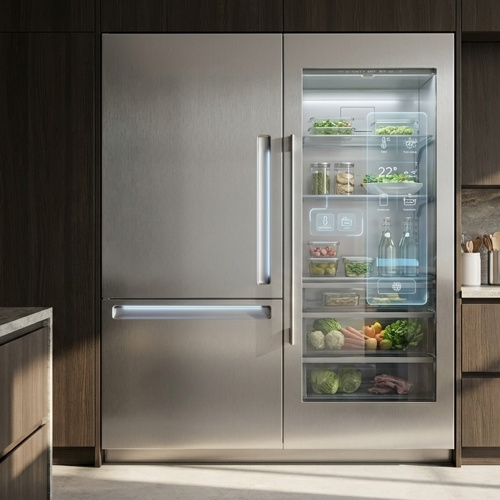
Status: available now
Cameras inside refrigerators that recognize what you put in them. Ovens that identify what is on the rack and set themselves. Samsung's 2026 Bespoke AI line is shipping in the United States with vision built on Google's Gemini. GE Profile's latest refrigerator scans barcodes to keep a running inventory and LG has its own version of the same idea. The demonstrations are impressive.
One thing you really need to think about whether your building or renovating is timelines and ecosystems.
Kitchens are not bought in one transaction, they accumulate. A refrigerator from one brand, an oven from another eight years later, a dishwasher chosen because it was the one in stock that week. Each appliance is intelligent inside its own app and its own ecosystem, and that intelligence stops dead at the brand boundary.
That is a standards problem rather than a technology problem, and wireless charging had exactly the same one a decade ago, when every phone maker had an incompatible pad. It got solved by agreeing on one standard that every manufacturer could build against, which is why a Qi2 Certified charger works with an iPhone and a Pixel and a Galaxy and nobody has to think about it.
So the future-proofing move for a connected kitchen is to favor appliances that speak an open standard, and to treat any feature that only works if you buy four matching appliances from one brand as a feature you will lose.
7. High-efficiency appliances
Status: available now, more common in Europe
Heat pump technology moved into laundry and kitchen appliances in Europe well before it did in North America, driven by the same electricity prices that made boiling taps sensible. A heat pump dryer recycles its own heat rather than venting it, and Miele reports its models use up to half the energy of conventional drying.
The efficiency picture on dishwashers has moved too. Miele's current dishwasher range carries the top A rating under the European energy label, which was recalibrated a few years ago specifically so the top grades would be hard to reach. Getting there requires real engineering rather than a marketing claim.
There is a longevity argument stacked on top of the energy one. European rules require manufacturers to keep spare parts available for large appliances for as long as a decade, and some brands go considerably further. Miele guarantees parts for fifteen years and builds to roughly a twenty year service life. An appliance engineered to satisfy that requirement tends to survive it, wherever you happen to buy the thing.
What to decide before the cabinets go in
Four decisions, all cheap to make early and expensive to revisit.
Pick a non-metallic countertop. Porcelain, quartz, sintered stone and natural stone all let energy pass through the surface. Metal does not, and that choice is permanent. It governs both wireless charging and anything cordless that comes later.
Leave access underneath. Charging hardware and Ki transmitters both live under the counter and both need somewhere to sit and a route to power. A cabinet run packed solid with drawers removes that possibility.
Decide on charging at fabrication. Wireless charging is installed while the counter is being made. There is no later.
Ask how long the appliance is supported. Spare parts availability and expected service life tell you more about what an appliance will cost you over twenty years than the feature list does.
Questions people ask
Which of these gives the most for the money? The in-sink dishwasher or the boiling tap, depending on whether your daily annoyance is dishes or waiting on a kettle. Both are available now, both are a few hundred to a few thousand dollars, and both change something you do every single day.
What can renters actually do? Countertop appliances, mostly. Everything else here involves fabrication or plumbing. Worth knowing what exists, though, for whenever the kitchen is yours.
Can any of this be added to a kitchen I already have? The in-sink dishwasher and the boiling tap, yes. Both are fitted to existing kitchens routinely. Wireless charging, no, it goes in during fabrication. Cordless appliance systems may work with an existing countertop depending on the cabinet and drawer configuration and the undercounter accessibility..
When can I buy a cordless kitchen appliance? Not yet. The standard is complete and certification is underway, with first products expected in some markets in 2027. The companies building them are listed at Cook With Ki.
Do smart appliances from different brands work together? Sometimes, partially, and less often than the marketing suggests. Appliances built to open standards are the safer bet for a kitchen you will assemble over many years.
The bottom line
The most interesting kitchen technology in 2026 is not sitting on the counter. It is in the counter, and underneath it. Power is starting to move through solid stone to phones now and to appliances shortly. Categories that have been ordinary in Chinese and European kitchens for years are turning up in American showrooms. Appliances are getting smarter individually and no better at cooperating.
None of it requires rebuilding anything tomorrow. It does mean that the next time your kitchen is open, a few small decisions about material and access will determine what you are able to add for the next twenty years. Worth making them on purpose.