How Magnetic Phone Chargers Work: The Snap, the Magnets, the Alignment
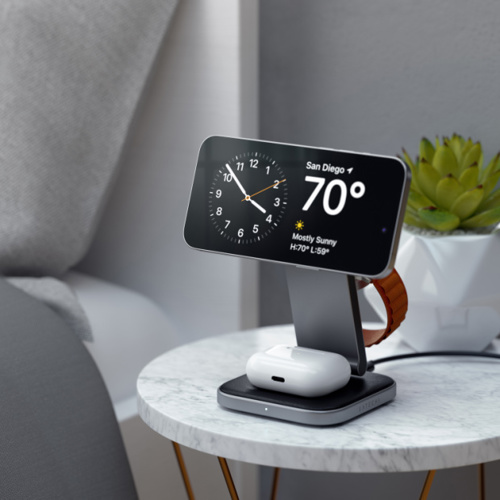 The magnets in a magnetic phone charger do exactly one job: they line your phone up. The charging still happens the way it does on any wireless pad, through two coils passing energy across a magnetic field. The magnets carry no power at all. They exist because coil alignment turned out to be the hardest problem in wireless charging, and a ring of magnets solves it without asking anything of you beyond letting go of the phone.
Key takeaways
- The magnets align, the coils charge. A magnetic charger snaps your phone's receiver coil directly over the transmitter coil, every time.
- The snap is a standard. Qi2's Magnetic Power Profile specifies the magnet ring's dimensions, layout, and strength so every certified phone and charger fits together.
- Fixed magnets don't interfere with charging. The field that transfers power alternates rapidly, while the alignment magnets simply hold still.
- Some phones need a magnetic case to join in. Qi2 Ready phones like the Samsung Galaxy S25 and S26 series have no magnets inside.
The problem the magnets solved
Flat charging pads made alignment the user's problem, and users, being human, were not great at it. Wireless charging transfers energy efficiently only when the coil in the phone sits centered over the coil in the pad. A centimeter off, and charging slows down while the missed energy turns into heat. For years, this was the gap between what wireless charging promised and what it delivered on a dark nightstand at midnight.
Magnets close that gap mechanically. Put the phone anywhere near the pad and the ring pulls it into the correct position, coil over coil, with a small satisfying snap. The pieces align themselves, so the transfer runs at its best without you thinking about it.
What's inside a magnetic charger
A ring of permanent magnets, arranged around the outside of the charging coil, with a matching ring inside the phone. When looking inside the iPhone 12, the first phone built this way, there were 18 magnets arranged so their polarity guides the phone toward center from anywhere nearby.
In Qi2, that arrangement became an open specification. The Magnetic Power Profile (MPP) defines the ring's dimensions, the layout and orientation of the magnets, and the holding force, and certification testing checks the magnetic pull and shear force along with everything electrical. That's why a certified charger from one brand snaps onto a certified phone from another as if they were made together. In a sense, they were.
The magnetic profile brought one further upgrade that never appears on the box: the phone and charger talk to each other at 360 kHz, a much higher signaling frequency than older wireless charging used.
Basically what that means is they exchange information faster. The two are constantly checking in, the phone reporting how full and how warm it is, the charger adjusting in response, and a higher frequency lets that back-and-forth happen quicker. The practical payoff is responsiveness: the charger reacts sooner when the phone heats up or the battery fills, which keeps the charge steadier and safer.
Do the magnets interfere with the charging?
No, and the reason is worth understanding, because it settles most of the magnet worries in one stroke.
Charging depends on a magnetic field that reverses direction thousands of times per second. The alignment magnets are static. They hold one position, sit outside the coil's path, and take no part in the energy transfer. If anything, they help it by guaranteeing the geometry the transfer needs. A Qi Certified magnetic charger runs more efficiently than a flat pad for exactly this reason.
The genuine magnet cautions are narrow and specific. Don't sandwich credit cards, security badges, passports, or key fobs between a phone and a magnetic charger. Samsung warns that the charging pad's electromagnetic field can damage bank cards and other magnetic cards, and recommends taking any cards out of a wallet case before charging.
Anyone with an implanted pacemaker or defibrillator should keep phones and chargers at a distance, per Apple's medical device guidance. And loose metal objects on any charging pad are handled by foreign object detection, the safety feature that withholds power from anything that can't identify itself.
Thick cases and metal cases are a different issue. They don't get damaged, but they widen the gap between the coils or weaken the magnetic hold, and either one costs you speed.
Three things people call a magnetic charger
The phrase covers three very different products and knowing which one you're holding matters.
Qi2 Certified magnetic chargers. These passed independent testing for power delivery, heat, safety, and interoperability, including the magnet strength itself. They deliver the full speed the standard promises, 15W or 25W depending on the tier, and every one of them appears in the WPC's public database.
Uncertified magnetic chargers. These have the magnet ring but skipped the testing. Without certification there's no guarantee they hit the speed the label implies, and the same corner-cutting that skips certification can skip thermal protection too. The magnet on the box is a feature you can see. Certification is the part you can't, which is exactly why it's the part worth checking.
Magnetic charging cables. A different technology wearing the same adjective. These use spring-loaded metal pins that click together magnetically, which means physical electrical contact, the same as any cable, with a detachable tip. No coils, no induction. They have their fans, but nothing about wireless charging applies to them.
The phones that need a case
Not every phone that supports Qi2 has magnets built in. The Samsung Galaxy S25 and S26 series and the OnePlus 13 are Qi2 Ready, which means they deliver the full magnetic experience once paired with an approved magnetic case. The case completes the ring, the phone provides the charging smarts.
Google went the other way: the Pixel 10 family ships with magnets built into the phone itself, the first major Android line to do so. Expect more to follow, since the accessory ecosystem is the same for everyone once the magnets are in place.
A few quick questions
Do magnetic chargers stop charging when the phone is full? Yes. The phone tells the charger when to ease off and when to stop, the same negotiation that governs every certified wireless charge.
Do the magnets drain my battery? No. Holding position takes no energy, and a phone snapped to an unpowered charger loses nothing.
Why does my charger connect for a second and then stop? Usually a case problem, a foreign object, or an uncertified charger failing the handshake. Take the case off, clear the pad, and if it persists, look the charger up in the certified product database.
Is a magnetic charger safe for my phone? A certified one, yes. The magnets are harmless to the phone, and the certification covers the heat and power questions that actually matter.
The bottom line
The snap is the point. Alignment is what separates fast, cooler wireless charging from the slow, warm kind, and magnets deliver alignment mechanically, every time, without your help. What the magnets can't tell you is whether the electronics behind them were built and tested properly. The Qi2 logo can. Check for it, then confirm the product before you buy.